
When you receive a peptide Certificate of Analysis (COA) or test report, do not begin and end with “99% purity.” First confirm that the document is authentic, that it matches the product batch, and that it actually measures what the seller claims.
This guide uses five laboratories seen in the European and US markets: Janoshik, Freedom Diagnostics, MZ Biolabs, Kovera Labs, and SGS. They were selected because their reports and verification methods represent different parts of the market. This is not a quality ranking or an endorsement.
Popularity is also not the same as scientific quality. The comments below use visible indicators such as operating history, public report volume, specialist reputation, verification access, and global laboratory scale. Where a laboratory publishes its own client or report count, that number is identified as self-reported.
1. What Should a Peptide COA Show?
A useful peptide report should include most of the following:
1. Report ID: Task Number, Accession Number, COA ID, or Sample Number.
2. Sample details: product name, labeled quantity, Lot, or Batch.
3. Identity: commonly supported by MS or LC-MS data.
4. Purity: commonly measured by HPLC or HPLC-UV and reported as a percentage of detected peak area.
5. Peptide content: the measured amount per vial, often shown as Amount, Net Content, or mg/vial.
6. Date and method: when the sample was analyzed and which test method was used.
7. Additional safety tests: endotoxin, sterility, heavy metals, bioburden, and other tests are normally separate from routine purity analysis.
Important: 99% purity does not mean that a vial contains the labeled number of milligrams. It also does not prove sterility, low endotoxin, low heavy metals, biological activity, or suitability for human use.
2. How to Verify a Peptide COA in Five Steps
Step 1: Request the complete PDF or a clear, uncropped image. A screenshot showing only the purity result is not enough.
Step 2: Check the QR code and destination. Many COA PDFs include a QR code that can be scanned with a phone camera to open the report-specific verification page. Before trusting the result, confirm that the page uses HTTPS and the laboratory's official domain. A QR code is a convenient link, not proof of authenticity. If the destination looks unusual, open the laboratory website independently and find its verification page.
Step 3: Enter the verification details exactly. A report may use a password, Search Code, Unique Key, Task Number, or Accession Number. Preserve uppercase and lowercase letters, hyphens, and other printed characters.
Common entry errors include:
- Confusing uppercase I, lowercase l, and the number 1.
- Confusing uppercase O with the number 0.
- Adding a leading, trailing, or internal space. Verification codes usually contain no spaces unless the report clearly shows one.
- Copying a code from a PDF with an extra space or line break.
- Changing uppercase letters to lowercase, or the reverse.
If verification fails, zoom in on the original PDF and compare every character. Remove accidental spaces and line breaks, but do not remove printed hyphens. If the laboratory has no public lookup tool, or the code still fails, contact it through its official website and provide the complete report.
Step 4: Compare the official record with the PDF. The sample name, batch, client or manufacturer, date, method, result, and units should match.
Step 5: Compare the verified report with the vial label. An authentic report for a different batch does not verify the product in your hand.
3. Five Laboratory Report and Verification Examples
3.1 Janoshik — Czech Republic, Europe
Official website: https://janoshik.com/
Official verification: https://janoshik.com/verification/
Public reports: https://public.janoshik.com/
Popularity and market position: Janoshik is one of the most visible independent names in the online research-peptide COA market. Its official materials state that it was founded in 2012, has more than 35 specialists, and is trusted by thousands of clients worldwide. The client figure is the laboratory's own claim, but its long-running public verification system also makes its reports easy to recognize and share.
Janoshik reports normally use a Task Number and Unique Key. Older reports may show janoshik.com/verify/, which currently redirects to the newer verification page.
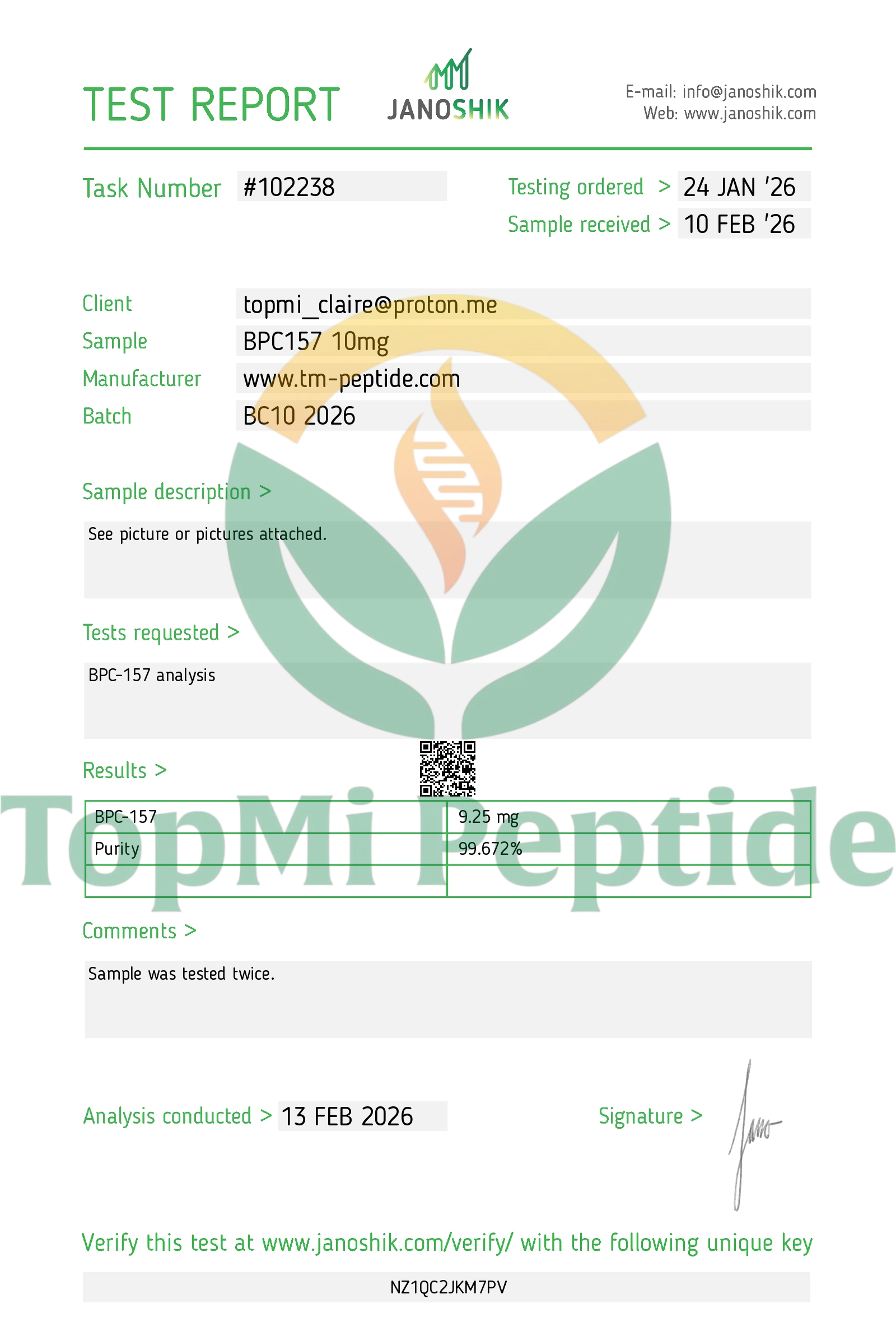
The BPC-157 report in the TM-peptide project provides a practical example:
- Task Number: 102238
- Sample: BPC157 10mg
- Manufacturer: www.tm-peptide.com
- Batch: BC10 2026
- Result: 9.25 mg
- Purity: 99.672%
- Analysis conducted: 13 FEB 2026
- Unique Key: NZ1QC2JKM7PV
Open the Janoshik website yourself, enter 102238 and NZ1QC2JKM7PV on the Verification page, and compare the official record with the report image.
The report supports high chromatographic purity and a measured peptide content of 9.25 mg for the submitted sample. It does not show sterility, endotoxin, or heavy-metal results, so those claims cannot be inferred from the 99.672% purity value.
3.2 Freedom Diagnostics — Tennessee, United States
Official website: https://freedomdiagnosticstesting.com/
Official COA lookup: https://freedomdiagnosticstesting.com/search-for-your-coa-based-on-the-unique-accession-number/
Popularity and market position: Freedom Diagnostics is a newer US laboratory, established in 2023, but it has built strong visibility through a searchable public COA database. Its website currently reports more than 42,000 public COAs. This is a self-reported live count, not an independently audited market-share figure, but it indicates substantial report volume in the US research-peptide segment.
The lookup page accepts a Search Code, Accession Number, or company name. A Search Code is normally formed from the first four characters of the company name plus the Accession Number, without spaces.
One public 5 mg report shows:
- Accession Number: 2606100516
- Search Code: Nati2606100516
- Purity: 99.90%
- Identity: Confirmed
- Net Content: 7.29 mg
- Methods: HPLC-UV and LC-MS
Enter Nati2606100516 on the official lookup page to open the original laboratory-hosted PDF:
https://coas.freedomdiagnosticstesting.com/Nati2606100516.pdf
This example shows why purity and content must be read separately. The sample was labeled 5 mg, while the measured net content was 7.29 mg. The displayed report does not include sterility, endotoxin, or heavy-metal results.
3.3 MZ Biolabs — Arizona, United States
Official website: https://www.mzbiolabs.com/
COA testing information: https://www.mzbiolabs.com/mzbiolabs/coa-testing/
Popularity and market position: MZ Biolabs has lower public-report visibility than Janoshik or Freedom Diagnostics. Its recognition comes instead from its specialist mass-spectrometry work, small-laboratory focus, and stated collaborations with corporate and academic clients. It is a useful example of a technically focused US laboratory whose reports may require direct confirmation rather than public database lookup.
An MZ Biolabs report may list the compound, client, lot number, analysis date, purity, method, chromatogram, and peak list. Some reports also compare theoretical and measured molecular mass to support identity.
A publicly available MOTS-C report lists a 10 mg label, Lot MK-225, 99.77% purity, an HPLC-UV-MS method, a theoretical mass of 2173.11, and a measured mass of 2173.08.
Third-party-hosted report copy:
https://biostrategix.com/wp-content/uploads/2025/11/COA_MOTS-C_10mg_lot-MK-225_2024-03-08.pdf
Two cautions apply:
- The 10 mg in the sample name may be the submitted label claim. Without a Quantitation, Amount, or Net Content result, it should not be presented as measured content.
- The PDF above is hosted by a third party and is not official verification. MZ Biolabs does not currently display an obvious public COA search tool, so send the full PDF, client name, lot, and date to the laboratory through its official website for confirmation.
MZ Biolabs also states that routine purity testing does not test biological activity, sterility or endotoxin, heavy metals, or pH.
3.4 Kovera Labs — Illinois, United States
Official website: https://koveralabs.com/
Official verification: https://koveralabs.com/#/verify
Popularity and market position: Kovera Labs has less publicly documented operating history and market-scale data than Janoshik or SGS. It represents a verification-first US model built around direct COA-ID lookup and separate purity, identity, content, and safety documents. Public verification is useful, but it should not be confused with long operating history or independently measured market share.
Kovera uses a COA ID. For example, entering KVR-2026-6E0B96 displays separate tabs for a Certificate of Analysis, Endotoxin Analysis, and Heavy Metals Analysis.
The main report shows:
- Product: Glow
- Batch: GW202603
- Labeled Quantity: 70 mg
- Blend Average Purity: 99.886%
- Blend Average Net Content: 75.64 mg
- Identity: LC-MS
- Method: RP-HPLC with a C18 column and DAD at 214 nm
This format separates the main composition report from additional safety tests. Open each document individually. If no Sterility report is present, the product should not be described as sterility tested.
3.5 SGS — Switzerland, Europe
Official website: https://www.sgs.com/
Official document verification: https://www.sgs.com/en-us/verify-sgs-documents-form
Peptide and protein testing information: https://www.sgs.com/en-us/services/cmc-quality-control-testing
Popularity and market position: By institutional scale, SGS is the most globally recognized organization in this selection. SGS reports more than 145 years of operation, over 2,500 laboratories and business facilities in 115 countries, and more than 100,000 professionals. These company-published figures show global scale, not peptide-specific market share. SGS may be less common than Janoshik on retail research-peptide websites because it is a broad testing, inspection, and certification group serving regulated and enterprise markets.
SGS laboratories offer peptide and protein quality-control services that may cover identity, purity, potency, quality, and safety. Available technologies include LC-MS/MS, UPLC, electrophoresis, endotoxin, bioburden, and ICP-MS. The exact report content depends on the tests ordered; an SGS logo alone does not prove that every possible test was performed.
SGS uses a document-submission verification process rather than a public peptide COA database:
1. Open the official SGS verification form independently.
2. Upload the complete PDF, or a ZIP file when several documents belong together.
3. Do not crop, obscure, or recompress the report. SGS states that a report number alone is not enough for verification.
4. For electronically signed reports, open the PDF in Adobe Acrobat and check the digital signature status.
5. Compare the confirmed document with the sample name, lot, method, specification, result, reporting SGS entity, report number, and issue date.
The SGS form accepts a single PDF or a ZIP file up to 20 MB. Unlike a public lookup portal, the report may not appear in a web search. That absence does not by itself prove the report is false; authenticity should be confirmed by submitting the complete document through SGS.
4. Which Laboratories Are Most Widely Recognized?
There is no reliable universal popularity ranking, because these laboratories serve different markets:
- Janoshik has the strongest niche visibility among the five for publicly shared research-peptide reports.
- Freedom Diagnostics has a high-volume, searchable US report database and publishes the largest public COA count among the selected peptide-focused laboratories.
- MZ Biolabs is better described as a specialist mass-spectrometry laboratory than a mass-market public COA platform.
- Kovera Labs is a verification-first US option with less publicly documented operating history and market-scale data.
- SGS has by far the greatest global institutional reach, but it is not primarily a retail research-peptide COA portal.
Popularity can help explain why a report format is familiar. It does not replace method suitability, laboratory competence, batch matching, or document verification.
5. Common Warning Signs and Entry Errors
- The PDF exists only on a seller's website and cannot be confirmed by the laboratory.
- The QR code opens a seller domain, cloud drive, or URL shortener instead of the laboratory website.
- The QR code opens a page that looks official, but the domain name does not match the laboratory's real website.
- A copied report ID, password, or Unique Key contains an accidental space or line break.
- Similar characters such as I, l, 1, O, and 0 were not checked before declaring a report invalid.
- The report shows “99% purity” but no product, batch, date, method, or report ID.
- The COA batch does not match the vial, packaging, or order record.
- An HPLC purity report is used to claim LC-MS identity, measured content, sterility, endotoxin, and heavy-metal testing.
- The same report is reused for several batches or unrelated suppliers.
- An old report is presented as proof for current inventory.
- A test result has no unit, method, acceptance limit, or clear pass/fail basis.
6. A 30-Second Peptide COA Checklist
1. Can you confirm the report through the laboratory's official website?
2. Does the QR code open the laboratory's official domain?
3. Did you check the exact case, spaces, and similar characters in the report ID or verification key?
4. Do the product name and batch match the physical item?
5. Have you checked Identity, Purity, and Amount separately?
6. Are sterility, endotoxin, and heavy metals supported by separate results?
7. Does the report apply only to one submitted sample?
A verified COA is an important starting point, not a final guarantee. It reports the results obtained for the submitted sample at the time of testing. It does not automatically represent every vial, the full batch, later batches, or the product's intended use.
View TM-peptide certificates: https://tm-peptide.com/certificates
Contact us to check a specific product document: https://tm-peptide.com/contact
This article is provided for research-material document review and purchasing due diligence only. It is not medical advice and does not indicate that any product is approved for human or veterinary use.